- Plea for Bruegel
- Posts
- Where is Bruegel?
Where is Bruegel?
Presentation of the book ‘Pieter Bruegel the Elder – Plejdoe:j vuur Bruegel’.

Luc Savelkoul
March 12, 2026
Pieter Bruegel, one of the most enigmatic and fascinating painters ever, disappeared into oblivion for centuries, about 100 years after his death (†Brussels, September 5 or 9, 1569), and with him, the knowledge of his birthplace. Towards the end of the 19th century, he was ‘rediscovered’ and since then (art) historians have been racking their brains over his place of origin.
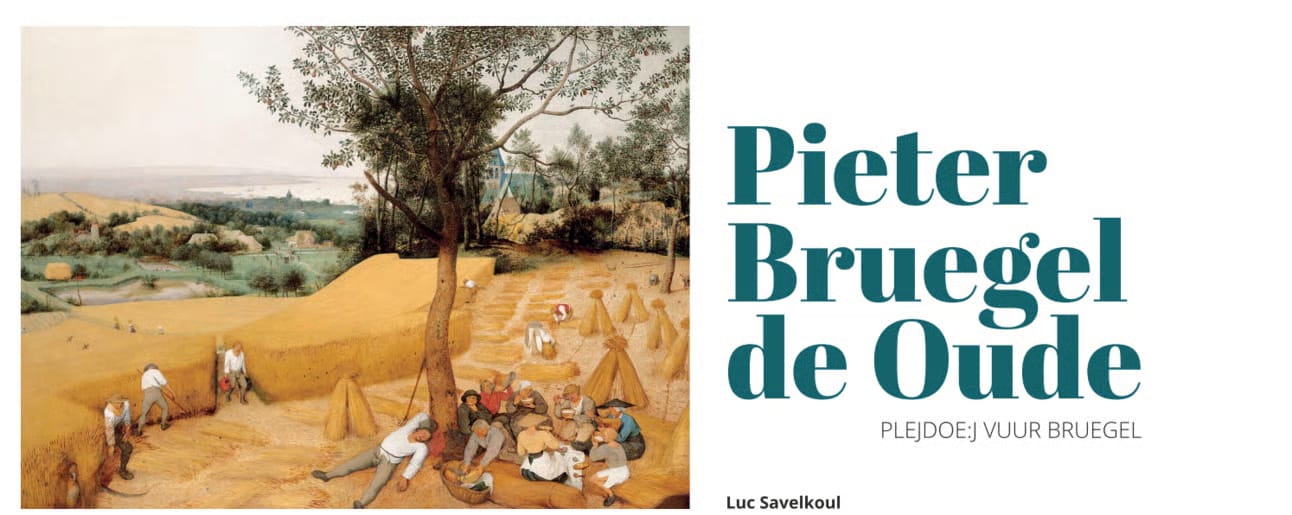
Luc Savelkoul (°Bree, Belgium, 1959), a lawyer in Beringen, has delved into this issue and presents his book ‘Pieter Bruegel the Elder – Plejdoe:j vuur Bruegel’. He has meticulously collected, organized, analyzed, and processed all the available evidence and source material from this ‘cold case’ in a book that reunites Pieter Bruegel the Elder with his birthplace almost 500 years after his birth. The book (written in Dutch, hardcover, 164 pages, 1.046 kg, 97 illustrations), also available in digital form, is self-published. It costs EUR 50 and is available from the author at 3583 Beringen, Paalsesteenweg 131 (Advocatenkantoor Advocom). The cost for shipping by post in Belgium is 11 EUR. Orders can be placed by email at: [email protected]. Payment can be made via:
BE37 2350 3163 3328.
Explanation from the author:
"Born in Bree and raised in Bocholt, I heard about the claim of the neighboring village of Grote Brogel [1] as early as my childhood in the 1970s: the great painter Pieter BRUEGEL the Elder was said to have been born there. The claim was usually laughed off, and anyone who took it seriously was not taken seriously. I even heard once that a playful trial had been held between Grote and Kleine Brogel to settle the dispute over the claim.
At the time of Pieter Bruegel the Elder's birth (between 1525 and 1530, probably 1526-27), the lordship of Groot Bruegel (Grote Brogel) was a sub-fief of the Lord of Bocholt. [2] The lord of Bocholt was the count of Horne, during Bruegel's lifetime successively Jacob III van Horne from 1502 to 1531, his brother Jan van Horne from 1531 to 1540, and Filips van Montmorency [3] , the stepson and heir of Count Jan van Horne, to whom his mother Anna van Egmond had remarried. He and Lamoraal van Egmont were beheaded on the Grand Place in Brussels on June 5, 1568.
My interest in Bruegel and his birthplace was rekindled after attending a lecture by Paul Capals on this subject for the Bocholt branch of the Davidsfonds in March 2010. Capals had already been researching the place from which Bruegel took/was given his name for many years. In 1994, he published a study with strong arguments in favor of the claim of Grote Brogel. [4]
On February 18, 2022, I attended a lecture by Tine L. Meganck on Ortelius in Bilzen. I hoped to learn more about Ortelius and his relationship with Bruegel. The lecture was organized by Erik Van Hove, an expert on and collector of old maps. A few days after the lecture, I contacted Erik Van Hove and asked him for more information about the map ‘BELGII inferioris descriptio emendata cum circumiacentium regiorum confinys’. His response and information accelerated my research and led me to the insight that I wrote down in the article that forms the main part of my book.
A first version of the article ‘Van welk Bruegel droeg Pieter Bruegel de Oude de naam?’ (Which Bruegel did Pieter Bruegel the Elder take his name from?) was ready at the end of May 2022. Responding to an invitation and offer from In Monte Artium, the scientific journal of the Royal Library Albertina, on the website In Monte Artium • KBR, I submitted it for publication. Somewhat to my surprise, I soon received notification that the article met the two conditions for publication: (1) a demonstrable connection with the KBR collection and (2) interesting. The article would be subject to peer review. [5] I considered it an honor, and there was something funny about it: a peer for Peer den Drol and Bruegelstad Peer.
On December 5, 2022, the peer reviewer and the editors of In Monte Artium gave their verdict:
“Your contribution violates a number of fundamental requirements for an article in a scientific journal, and the argument on which you base your reasoning is actually flimsy and of little real substance. If you wish, I can send you the peer review report.”
Even after reworking and supplementing the article, the peer reviewer and the editors of In Monte Artium refused to publish it. After this final rejection, I chose to publish my findings in book form. The revised version of my article for In Monte Artium, as submitted on March 11 and supplemented with some later findings and further substantiation of the language argument by Prof. Emeritus Luk Draye of KU Leuven, forms chapter 1 of the book. You can read about the further course of events and more about the peer review in chapter 2. Chapter 3 invites the reader to take note of the findings of my research and the criticism thereof and to form their own opinion on that basis. At the same time, the publication of the study and its evaluation provides insight into the technique and scientific approach of a peer review. The epilogue began as a short, light-hearted ending with a few loose ends and facts, but gradually grew into a chapter 4 with an overconfident but non-committal hypothesis from a history amateur.
After the publication of my book, I conducted further research into possible evidence for my hypothesis. This website was set up to publish the results of this research.
Interview with Jana Smeets, VRT Radio 2 Limburg, on November 23, 2023.
Click on the link below.
NOTES
[1] Grote Brogel was still an independent municipality at that time, but since 1977 it has been a sub-municipality of Peer
[2] When Count Jacob III van Horne (Weert? ca. 1480, †Vercelli, August 15, 1531) took office in 1502, the lordship of Bocholt was given as a dowry to Everhard IV van der Marck, Lord of Arenberg (date and place of birth unknown, †Brussels, November 22, 1531) and his wife Margaretha van Horne (date and place of birth unknown, †Weert, August 30, 1522), lady of Bocholt. This marriage ended decades of (armed) conflict between the House of Horne and the House of der Marck. Upon the death of Everhard IV van der Marck, the lordship of Bocholt remained in the possession of the House of Horne. Everhard IV van der Marck was a first cousin of Everhard/Erard van der Marck (born in Sedan on May 31, 1472, died in Liège on February 16, 1538), Prince-Bishop of Liège from 1505 until his death in 1538.
[3] The titles on the tomb of Philip of Montmorency, made and installed in 1841 in St. Martin's Church in Weert, read: Count of Horne, Lord of Weert, Altena, Nevele, Cortessem, Bocholt, and Breugel (sic).
[4] Paul Capals. Grote Brogel, the birthplace of Pieter BRUEGEL the Elder, Breughelkring Peer, 1994
[5] Peer review is also translated as collegial assessment